


DEVOTED TO ENVIRONMENTAL PROTECTION AND DELVED INTO POLAR RED TIDE: HO KIN-CHUNG DEDICATED HIS LIFE TO SCIENCE AND SERVING THE WORLD

As a Christian, KC is often asked why he did not choose Chung Chi College. “At the time, colleges were assigned by the university. Only Chung Chi College and New Asia College offered the Department of Biology, and I was assigned to New Asia College between these two options.”
Alumnus Ho Kin-chung (KC) (79/NA/Biology) is a pioneer of environmental protection in Hong Kong. He was among the first to join the Environmental Protection Department (EPD) of the HK government before embarking his teaching and research journey. He has been dedicated to research in red tide for four decades, and became an expert in the area. He even extended his research in red tides to the Arctic and Antarctica, and has set foot on both poles 30 times. After he retired, he donated millions of dollars from his retirement savings to establish the Bauhinia Station of the Polar Research Institute of Hong Kong in the Arctic, and even started his business for the first time at the age of 60 in transforming red tide-causing microalgae into a tool for purifying water. He made numerous contributions to science throughout his life. He described himself as a person “without having regrets about his youth, living up to the expectations of the country and family, having a clear conscience toward nature, and having the courage without fears”, which encapsulated his philosophy: “Similar to life, scientific research resembles a winding path which is not an easy journey, but as long as you put your heart into it, you will definitely find meaning in it.”
KC explained his choice to study Biology as being related to his upbringing: “My mother grew a number of potted plants at home, and left the watering tasks with me. Moreover, she raised rabbits and chicks at home, and left the pet feeding with me again. Witnessing their growth, I really wished to unravel the mysteries. When my father asked me about my interests when I was in Form Six, I answered Biology without hesitation.”
KC’s father believed that he should have studied medicine amid his outstanding academic performance to help people, but he had a different perspective. “My brother studied medicine, and given my academic results, I was qualified to be admitted to a medical school. However, while I like to see life flourishing, I can’t bear to see patients aging and passing away, so studying Biology suits my own preference.”
KC was very grateful to his father for his understanding and allowing him to choose independently. However, his father was also worried about his future after graduation. “Most graduates from the Department of Biology went on to either teach in secondary schools or work for the government. But at the time, I felt that being a teacher was monotonous and it was difficult to innovate; also, I found the government job boring as every step is in a routine. I didn’t like either of them at the time.” In the end, he first joined the EPD and then taught at the Open Learning Institute of Hong Kong. “After going round in circles, I ended up as a lecturer and working for a government job, and they were the two most enjoyable jobs of my life.”
Getting in Shape while Studying at CUHK
Life at CUHK is vibrant. KC said there are countless unforgettable memories. “In my first year, I went on a winter camping with Professor Mak Kai-keung. We stayed on the peak for a week and collected samples from streams and hills for research. I remembered that I huddled up in the tent at night, and when I woke up the next early morning, the mountain was covered in a sea of white and was indeed frosted up. That scene is still vivid in my mind.” Another memory comes up with Professor Hu Shiu-ying. “We often went with her to collect plant specimens in the wild. She was always energetic, climbing to the peak at a stretch and then sitting calmly waiting for us. She often encouraged us to stay fit. Later, when I became a teacher, I walked faster than the students in the wild, and told them the same things.”
He is very grateful to CUHK for training his physique amid his academic studies. “Most of the Biology classes were held in the Science Centre, while the general education and language classes were held at New Asia College. Not to mention rushing to Chung Chi College to catch the train for which I ran from the top of the mountain to the bottom every day. This high-volume exercise trained my physique competent for a marathon. I joined the first Standard Chartered Hong Kong Marathon in 1997 until 2005, and finished the full marathon within three hours. This was indeed what CUHK trained me up.”

KC (first from right) became close friends with all the members of the CUHK fellowship, and more than 40 years later, they remain in touch and continue to meet regularly.
Foreign Teachers Said, “China Needs You”
Upon completion of his studies at CUHK, as KC said, he neither wished to teach nor join the government, so he discussed his future path with Professor Mak Kai-keung and Professor Wong Ming-hung. “They both believed that environmental science was the future trend and guided me to the path of research. Professor Wong had previously studied in the United Kingdom and forthwith wrote a letter of recommendation for me to the local university, so I went to study in Salford, the United Kingdom.”
Upon completion of his master’s level research degree at the University of Salford in Greater Manchester, as a matter of course, he applied to pursue a doctorate. He received offers from two universities and ultimately chose the University of Liverpool. “Before leaving, I said goodbye to three foreign teachers. When they knew that I was going to pursue a doctorate, they fell silent and asked me if I had considered my course of life.” It turned out that all three teachers had chosen to work abroad after graduation of their master’s degrees to gain experience before returning to pursue their doctorates. “Since environmental protection accords great emphasis to hands-on experience, they believed that no matter how many dissertations you write or whether you work as a dean, it doesn’t really help the world much. They knew from the news reports about the pollution of rivers and mountains in Hong Kong and the environmental problems brought about by reform and opening up in China, and thought I should go back to serve the society. They even told me that ‘Hong Kong and China need you!’ I was deeply impressed by these words uttered from foreigners.”
Environmental Protection Does not Necessarily Mean Dumping Garbage
“Hong Kong needs you”, as the teachers said, may not reflect reality. Upon returning to Hong Kong, KC recalled that he initially struggled to find a job. “It has taken some time waiting for the government to open new positions, and together with written tests and interviews, it took almost a year to finally get an offer at the EPD. While waiting, I worked as a science editor at a publishing company, and was responsible for revising primary and secondary school textbooks. Thus, I often tell youngsters that the path of life is often winding, but it can enrich your life.”
Joining the EPD in 1981 and leaving in 1992, KC witnessed the development of environmental protection in Hong Kong over a decade. “I recalled that when I went to study in the United Kingdom, all my relatives came to Kai Tak Airport to see me off. One of my relatives with a university degree asked me what environmental science was all about. I patiently spent five minutes explaining to him how the earth is polluted and the significance of environmental protection. However, when we were going through the gate, he said, ‘You can do it! There is a lot of garbage in Hong Kong for you to dump after you return.’ Evidently, from the perspective of Hong Kong people at the time, environmental protection was simply about handling garbage!” He said that he started from scratch when he first joined the EPD. “In terms of the EPD headcount ranging from the director to the pantry assistant, there were no more than 40 employees. When we went to meetings at the government headquarters, the chairman sat on one side of the long table, and the EPD staff were always at the far end. Moreover, 70-80% of the agendas were irrelevant to environmental protection. The chairman would only politely ask if we had any concern about environmental protection at the end before adjourning the meeting. It’s clear how low the status of the EPD was at the time.”
As pollution worsened around the globe, society began to accord priority to environmental protection, and until the media were increasingly concerned about environmental protection issues would the situation gradually change. “We sat closer to the front in government meetings, and the EPD’s views were often sought at the start of each meeting. The EPD had expanded to 1,600 employees when I left. I recalled that when my son was studying in kindergarten, he had already told me to use fewer plastic bottles and use handkerchiefs more often, so environmental protection was no longer simply a research topic at the university. Of course, environmental protection later became a fundamental human issue, and related to all industries, policies and research — something that I have never imagined. I could ultimately tell that relative that environmental protection does not necessarily mean dumping garbage!”

The current Secretary for Environment and Ecology, Tse Chin-wan (third from right), and KC (third from left) were colleagues at the then Environmental Protection Department. “I was in charge of water quality, and he was in charge of air quality.”
Embracing Tolo Harbour Again
In his sixth year working at the EPD, KC was transferred to the Water Quality Policy Division to manage the water quality of Tolo Harbour. “I forthwith recalled my life at CUHK. Tolo Harbour was a part of my four years of study. I used to row boats in the water at the time, and the sense of familiarity immediately came up with my mind. At the time, the seawater in Tolo Harbour often turned red. My senior classmates from the Department of Biology told me that it was a red tide. As Shatin had developed into a new town with the population rapidly increasing from 50,000 to 500,000, pollutants increased dramatically. Meanwhile, the pollution from the dyeing and finishing plants in Fo Tan led to the growth of a large amount of algae, which turned the seawater red. 43 cases of red tides were reported in Tolo Harbour one year, once every less than 10 days. The situation was critical.”
The words “red tide” were etched on his mind. He worked hard to observe and study, and he knew the problems from the academic perspective, but lacked substantial data to support his philosophy. “At the time, I was ambitious to help Hong Kong solve this problem, so I raised the issue to my supervisors that as long as a small amount of resources were allocated, I could conduct relevant research and formulate a solution to the red tide to benefit society.” However, the relevant party threw cold water on him, saying that the EPD was responsible for conducting investigations to support policy implementation, and that he should go back to the university if he wished to conduct research. “I tossed and turned that night and couldn’t fall asleep. In my mind, my supervisors asked me to go back to the university, and I have not fulfilled my ambition to pursue a doctorate. I forthwith wrote to several departments at the University of Hong Kong (HKU) the next day to see if there would be any response.”
Ultimately, Professor John Hodgkiss, the head of the Department of Botany, met with KC and, after listening to his research proposal, forthwith admitted him as a doctoral student. “I had considered pursuing my studies full-time, but the professor said that my job at the EPD would make it more convenient to collect and analyse data for my research project. At the time, I was working in Wan Chai, and after work at 5:30 pm, I would take the bus directly to HKU and work until 9:00 pm every night before going home. In the end, I completed my dissertation in just three years and even won the Best Dissertation Award.”
Meeting with Director Turned out to be a “Hongmen Banquet” for a Job Interview
The HKU graduation ceremony was held at the Hong Kong Coliseum. All the doctoral students sat in the first row, and the VIPs sat in the second row. “An Indian-Malaysian VIP shook hands with me and exchanged pleasantries. When he heard that I studied Botany, worked at the EPD and conducted research on red tide in Tolo Harbour, his eyes immediately opened wide. It turned out that he also majored in Botany and was interested in environmental protection. When I received his business card, I realised that he was Professor Gajaraj Dhanarajan, the Director of the Open Learning Institute of Hong Kong. He even invited me to his office for a chat.”
Professor Dhanarajan’s secretary called the next day, and invited KC to his office for a gathering. “When I arrived, I realised that it was a ‘Hongmen Banquet’. When I saw the director, deputy director, dean of the school of science and human resources manager sitting in a row, I knew something was wrong. It turned out to be a job interview! The director explained that they wanted to organise the first environmental protection course and had been looking for a course director for months but were in vain as the candidates lacked either hands-on experience or a doctoral degree. As I had both, I became their preferred candidate.”
Embarking on a Journey to the Polar Regions
Embarking on the polar journey began with his work at the Open Learning Institute of Hong Kong. “In 1993, the Minister of Education of Xinhua News Agency visited the institute and my laboratory. He was interested in my research and invited me to join the China Youth Environment Forum held in Beijing two weeks later. I readily agreed. However, he called me again a few days later, asking me if I could give a keynote speech at the opening ceremony with the topic ‘Environmental Issues in Hong Kong – A Retrospect and Prospect’. So I wrote the speech in three days and set off for Beijing, and found that I was asked to deliver a speech at the Great Hall of the People. I ultimately became the first Hong Kong scholar to deliver a speech there.”
One of the biggest takeaways from this event was meeting the distinguished guest Dr Rebecca Lee Lok-sze, who invited him to conduct a polar expedition. “However, there was no news for half a year until one day, Dr Rebecca Lee suddenly called and said we would be departing the following week. I felt surprised. When I discussed it with my wife, she initially misheard Antarctica for Nanjing and thought it was just an ordinary business trip. When I corrected and told her that it was Antarctica, she realised that I was confident and competent to handle it and fully supported me, provided that I returned safely.” The day before departure was their 10th wedding anniversary, and they had planned to celebrate and have a candlelight dinner at a hotel. “In the end, we did not have a dinner and instead went to a department store to buy warm clothes and equipment.”
On his first trip to Antarctica, KC collected samples of seawater, plankton and shellfish. He discovered that the seawater was not contaminated by the red tide, but the shellfish contained red tide toxins, leaving him completely baffled. “Bearing the spirit of a scientist in mind, I had to pursue the answer to the end. So, in 1995 and 1996, I went to the Arctic with Dr Rebecca Lee, but the results were still the same.” In 1999, Dr Rebecca Lee arranged for him to board the icebreaker Xue Long, and the mystery was finally unravelled. “Xue Long is equipped with deep-sea sampling equipment that can obtain seawater samples from a depth of 150 meters. In conventional marine research in Hong Kong, only samples from depths of 5 to 10 meters were taken for research since sunlight cannot penetrate seawater deeper than 10 meters, which prevents algae from carrying out photosynthesis. However, I forgot that polar seawater was extremely clear, so it was necessary to collect samples from even deeper waters. With the assistance of Xue Long, we finally found red tide samples in seawater at a depth of 30 meters.”

KC (third from right in the front row) once organised colleagues from the Open University of Hong Kong to conduct scientific research expeditions to Antarctica.
To continue conducting research on the causes and mechanisms of red tides in the polar regions, KC has made numerous expeditions to the polar regions. This year, he just completed his 30th polar expedition, which included 24 trips to the Arctic and 6 trips to the Antarctica. “The most breathtaking one was in 2000. The sea was extremely rough, with waves reaching 30 meters high. We could not sit on the ship but we had to fasten the safety belt and lie down to sail. During the 15-day voyage, I barely ate anything and found that I had lost 16 pounds when I returned. However, I was able to collect numerous samples of Alexandrium algae for research, which was well worth it.”
Having spent over 30 years of polar expedition, KC, as he got older, was worried about how many more times he could go to the polar regions again. “I started thinking about how to pass on the torch, especially since polar research is uncommon and difficult to secure fund support. So when I retired in 2018, I decided to donate my millions of dollars from retirement savings to rent a place in the Arctic to establish the Bauhinia Station, hoping that it could become a platform to provide support to the next generation in polar research.” However, he admitted that he dare not tell his wife beforehand about the donation of his retirement savings. “Before I retired, she kept asking me about my investment plans of the retirement savings, and I always gave evasive answers. Even after retirement, I dare not to give her an answer directly. Not until one day did my wife find out that when a reporter interviewed me and published the news about my donation of the retirement savings to establish the Bauhinia Station. Not only did she not blame me, but she also reminded me to pray, saying that success could only be achieved through God’s strength. I was touched to tears at that moment.”
Whether a Red Tide is Good or Bad Depends on One’s Mindset
Having devoted his life to environmental protection, KC believes that environmental protection should not only be driven by passion and ambition, but also firmly grounded in science. “Environmental conservation is originally named Conservation, which also means management. Management focuses on wisdom and values, and both of these aspects must be based on knowledge. I am pleased to find that environmental awareness in Hong Kong is gradually increasing, and the grassroots are also concerned about it, but it cannot simply remain superficial.”
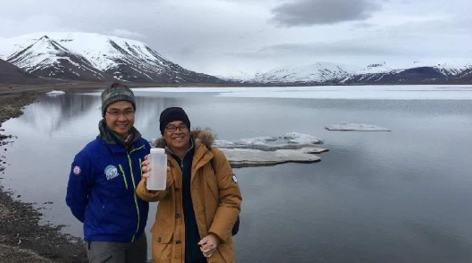
His son (left) had already gone to the Arctic with him when he was 13 years old. He also loves scientific research, and both of them have been working side by side on their long research journey for years.
Speaking of the reasons for entrepreneurship at the age of 60, he said, “I had been conducting research on red tides for 40 years and publishing a number of dissertations, but red tides still emerged around the globe, which felt pointless. So, in the years before my retirement, when I was less busy with official duties, I began to re-examine the data of Tolo Harbour and found that red tides emerged and disappeared naturally. It turned out that this harbour was an ideal natural laboratory for research.” He explained that the occurrence of red tides resembles a volcanic eruption. When pollutants accumulate to the highest level, and nitrogen and phosphorus in the seawater reach their peak, a red tide will emerge. Then, the microalgae that it brings will intake the nitrogen and phosphorus, allowing the seawater to return to normal. “We have believed that microalgae was harmful for years, but similar to the debate between garbage and resources, whether microalgae is harmful or beneficial depends entirely on subjective judgement of humans. When I talked to Lin Huangquan (09/GS/ Doctor of Philosophy in Biochemistry (Medicine)), the Executive Director of the Shenzhen Research Institute (SZRI) of CUHK, he thought this idea was amazing and fully supported my entrepreneurship.” Currently, in addition to treating wastewater, microalgae can also produce various products such as antioxidants, astaxanthin, carotene and major components of shampoo, and can absorb carbon to reduce global warming. “Entrepreneurship is arduous, and it is something that I have not yet succeeded in. I will definitely continue to work hard until I find a successful business model.”
KC in the Eyes of His Wife, Alumna Katie Fung (95/CC/Nursing)
KC and I have known each other since Form One. I admire his ever-present smile, optimistic and positive mindset, insightful thinking and unique character. For instance, when he hears a friend pointing out one’s shortcomings, he can always forthwith point out one’s strengths, thereby changing stubborn and negative opinions.
KC is highly enthusiastic about learning and research. During his spare time every evening, he reads different types of books in his study room, which he considered an enjoyable moment. While having dinner with his family, he would open up to each other to talk frankly and share insights causally, including workplace and school activities, current affairs, family matters and national affairs. So, my children had broad horizons at a very young age and were able to have their own stance and unique insights, who were commended by university professors and lecturers.
He loves research. Whenever he finds the seawater turns red, he always takes the time to collect water samples for testing. He finds self-fulfilment in the results and enjoys sharing them with others. He is curious about the nature and passionate for studying aquatic ecology, which is truly admirable! When I noticed that KC had donated his retirement savings to establish the Bauhinia Station in the Arctic, I felt shocked yet calm. He earned the retirement savings through his own work, and he has the absolute right to dispose of it as he sees fit (of course, I would prefer he discussed it with his wife beforehand!). Polar expedition, environmental protection and science popularization are meritorious that will benefit future generations. It is definitely good.
I suffered from encephalitis in 2005. Fortunately, KC took care of me and taught me despite his busy schedule. My children were patient and supportive, and never complained or felt pain or loss. So I am very grateful that my relationship with my husband and children has become even closer.
 His wife (right) has accompanied KC to the Arctic three times and the Antarctica once.
KC in the eyes of Financial Secretary, Alumnus Paul Chan (77/NA/Accounting; 84/GS/Business Administration)
To me, KC is highly professional, determined and resilient. He is approachable and always takes the time to explain scientific matters patiently and in detail. What impresses me most is his passion for scientific research and his strong sense of mission.
In 1993, we travelled together to Antarctica on an expedition. Each team member had a distinct role: some were responsible for logistics, while KC and several others undertook scientific research. Before departure, we trained hard to prepare ourselves physically for the challenges ahead. Although living conditions and meals were basic, everyone remained enthusiastic and determined, looking out for one another throughout the expedition. What I remember most vividly is KC braving the wind and waves in a small boat to collect water samples, which he brought back for analysis to study the local water quality and ecological environment. His wholehearted dedication to sampling and research reflected a level of professionalism that I deeply admired.
 In 1993, KC (third from right) went to Antarctica in the name of the “Hong Kong Association for the Advancement of Science & Technology”, accompanied by Paul Chan (second from left), who served as the treasurer of the Association.
KC in the eyes of Alumnus Lin Huangquan
I know Professor Ho as we have a common background: both of us are a CUHK graduate and concerned about scientific research and development in Hong Kong and the Greater Bay Area. In my eyes, Professor Ho is a highly mission-driven and action-oriented scientist. He has been dedicated to environmental protection work for over 40 years and is also a polar explorer, specialising in marine microalgae, lichens and glacial pollution in the polar regions. More admirably, he donated his million-dollar retirement savings in May 2018 to contribute to scientific research, education and talent development related to the Arctic and Antarctica. He is a scholar who is willing to pour all his retirement savings into expanding the blueprint of polar research in Hong Kong. His selflessness and dedication are deeply admirable.
More importantly, Professor Ho is a scholar who truly embodies the unity of knowledge and action. He not only lectures on environmental protection, but also personally funds his own research trips to the polar regions, commences entrepreneurship in Shenzhen. He has visited the Arctic and Antarctica 30 times, and even formed a startup team at the age of 60 — a spirit worthy of our full support. For the “Xue Long 2” visit to Hong Kong in 2024, Professor Ho served as the chairman of the executive committee. The “Xue Long 2” visit promoted Hong Kong citizens’ understanding of the national polar expedition work. As a member of the organising committee and vice-chairman of the executive committee, I felt honoured to participate. CUHK thus forged a connection with polar-related endeavours, laying a solid foundation for subsequent polar-related scientific research, talent cultivation and translation of research results.
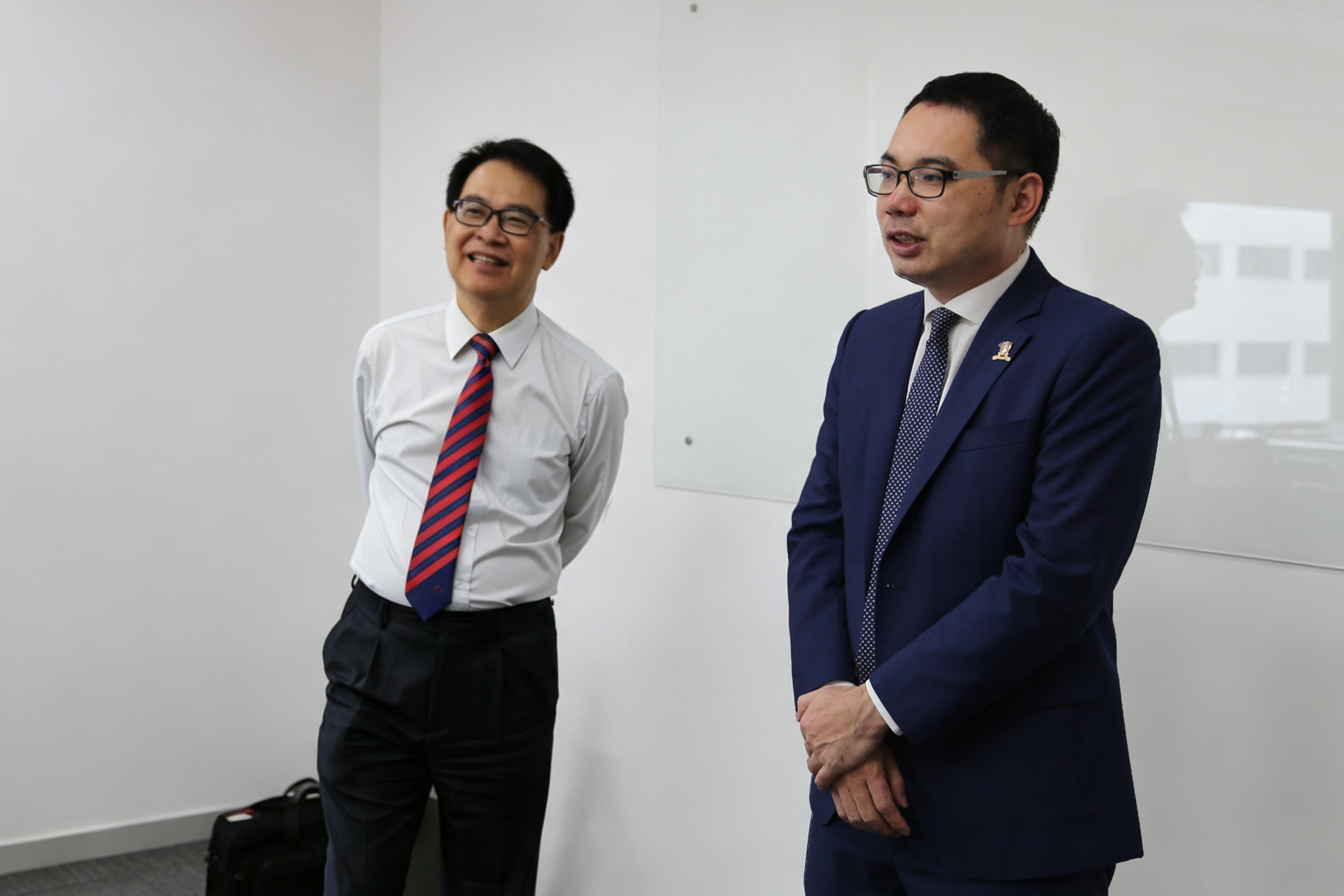 Lin Huangquan (right) supported KC in entrepreneurship and began a series of collaborations at the Entrepreneurship and Innovation Hub (InnoHub), SZRI.
Ho Kin-chung’s Journey
- 1979 Bachelor of Science, The Chinese University of Hong Kong
- 1980 Master of Science in Environmental Resources, University of Salford, United Kingdom
- 1981 Water Policy Group, Environmental Protection Department
- 1991 PhD in Botany, The University of Hong Kong
- 1992 Senior Lecturer and Programme Director, Open Learning Institute of Hong Kong
- 2004 Awarded the Bronze Bauhinia Star by the Hong Kong SAR Government
- 2018 Established the Bauhinia Station of the Polar Research Institute of Hong Kong
Published on CU Alumni Magazine Issue 127 by Alumni Affairs Office 2026
Read online: CU Alumni Magazine Issue 127 (Chinese Version Only)
PDF: https://alumni.cuhk.edu.hk/communication/cuam/202609/
ISSUU: https://www.alumni.cuhk.edu.hk/magazine/issuu/